

 English
 русский

Long Shaft vs. Short Shaft: Choosing the Right 9.9HP Outboard Engine
Among the technical details that influence how a 9.9HP outboard engine performs, shaft length stands out as one of the consequential. An otherwise well-matched engine can deliver disappointing results if the shaft length does not align with the boat’s transom. Understanding this relationship helps owners avoid common problems and select a configuration that allows the engine to operate as designed.
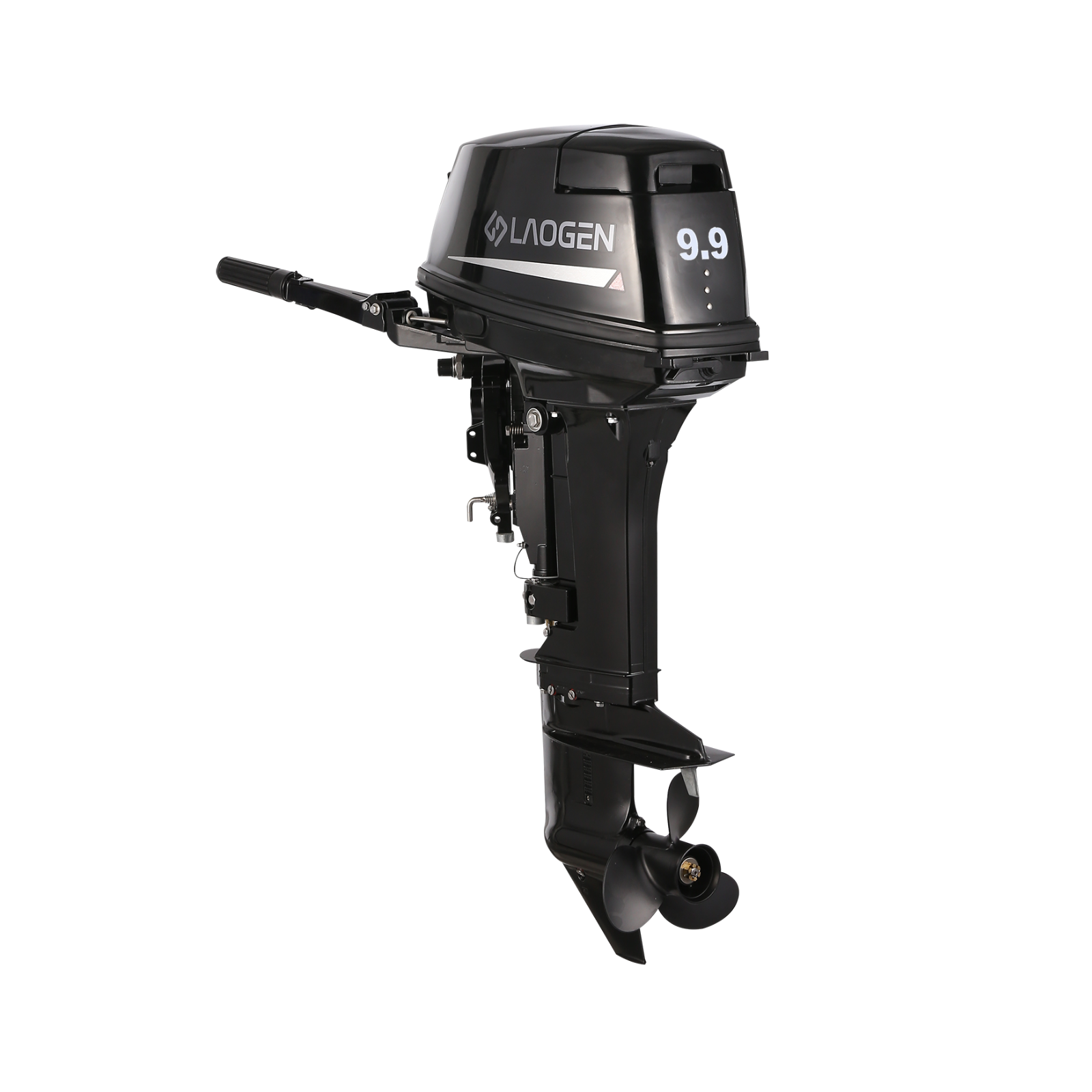
What Shaft Length Means
Shaft length refers to the distance from the engine’s mounting bracket—where it attaches to the transom—down to the anti-ventilation plate, a flat surface located just above the propeller. This measurement determines how deep the propeller sits in the water relative to the boat’s hull. Standard shaft lengths fall into categories, with short shafts typically measuring around fifteen inches and long shafts around twenty inches. Some applications call for extra-long shafts, though these are less common in the nine-point-nine-horsepower class.
The appropriate shaft length for a given boat depends entirely on the transom height, which is the vertical distance from the top of the transom to the point of the hull where the water flows.
The Consequences of a Mismatch
When the shaft is too short for the transom, the anti-ventilation plate sits above the bottom of the hull. Under power, the propeller draws air down from the surface, causing ventilation. The engine revs higher, but the boat loses forward thrust, sometimes dramatically. Ventilation makes planning difficult, increases fuel consumption, and places strain on the engine as it operates outside its intended range.
Conversely, a shaft that is too long places the engine deeper than necessary. The added drag from the extended lower unit slows the boat and can cause handling issues, particularly in shallow water where the propeller or gearcase may strike bottom. Excess depth also affects the angle of thrust, potentially causing the bow to ride lower than intended.
Neither condition allows the engine to perform efficiently, and both can increased wear over time.
Measuring Transom Height
Determining the correct shaft length begins with a simple measurement. With the boat on a trailer or in calm water, measure from the top center of the transom straight down to the bottom of the hull at the keel line. This distance indicates the transom height. A measurement of nearly fifteen inches calls for a short-shaft engine. A measurement of nearly twenty inches requires a long-shaft engine.
Variations exist, and some boats fall between standard sizes. In those cases, a slight tolerance allows some adjustment through mounting height, but significant mismatches cannot be corrected by simply raising or lowering the engine on the transom without affecting steering and trim.
Boat Types and Common Configurations
Small aluminum jon boats, inflatables, and many lightweight fishing skiffs typically use short-shaft engines. These boats have relatively low transoms designed to keep weight low and simplify handling. Larger aluminum boats, fiberglass hulls, and models intended for rougher water often feature taller transoms that require long-shaft engines.
The trend toward deeper hulls in many modern boat designs means long-shaft configurations have become more common than in past decades. Buyers purchasing a used engine for an older boat should verify the transom measurement rather than assuming the previous setup was correct.
Making an Informed Selection
Before committing to a 9.9HP outboard engine, measuring the transom takes only a moment and provides certainty. For those purchasing an engine without the boat present—such as when upgrading or replacing a powerhead—having this measurement on hand prevents costly mismatches.
Owners who occasionally use the same engine on multiple boats face additional considerations. A short-shaft engine may work on a taller transom with a transom riser or jack plate, though such adaptations add complexity. A long-shaft engine used on a short transom remains too deep regardless of mounting adjustments. In situations where versatility matters, selecting one shaft length and choosing boats that accommodate it simplifies the arrangement.
Shaft length may seem like a minor detail, but it directly affects how well an engine performs on the water. A properly matched combination allows the propeller to operate in clean water, delivers the thrust the engine was designed to produce, and contributes to predictable handling in a variety of conditions.

Get in touch

- Phone: +86-13606682703
- Email: [email protected]
- Tel:
- Add: Lingang Industrial Park, Jiantiao Town, Sanmen County, Taizhou City, Zhejiang Province, China.


